The Art of Jonty Hurwitz & Yifat Davidoff

    The Art of Jonty Hurwitz & Yifat Davidoff

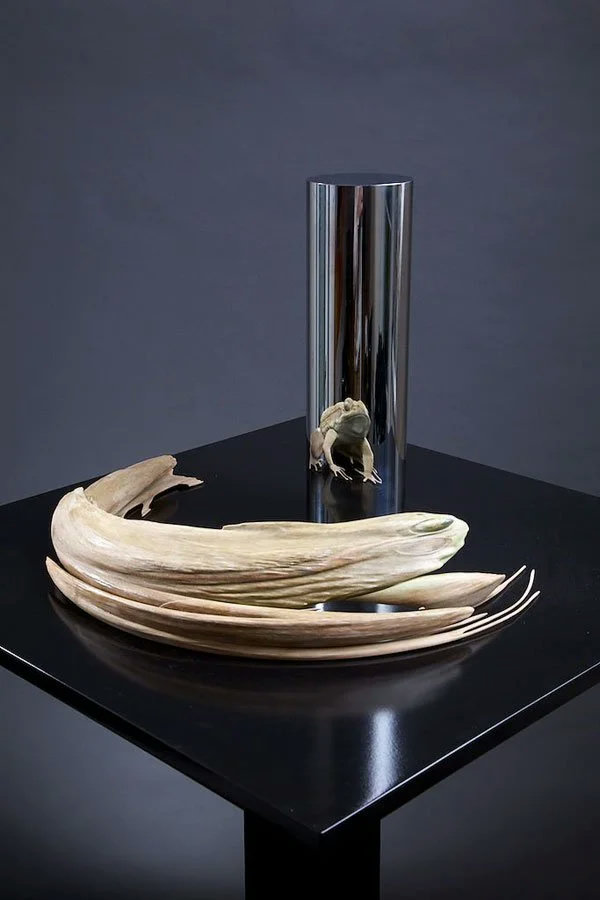
    Kiss of Chytrid by Jonty Hurwitz: an abstract curved bronze form beside a polished cylindrical mirror that reflects a frog
    Jonty Hurwitz, Kiss of Chytrid (Bronze), 2015. The physical form and its mirror reflection, seen together.

    Art · Mathematics · Perception

    Anamorphosis: Definition, History & the Art of Hidden Images

    What if an object could hide its true identity in plain sight?

    For centuries, artists have used mathematics and optical illusion to create images that appear distorted, fragmented or even meaningless—until you look from exactly the right place.

    This is anamorphosis: an extraordinary meeting of art, geometry and human perception.

    From Leonardo da Vinci's Renaissance experiments to the computational sculptures of Jonty Hurwitz, discover how artists have transformed the act of seeing into an artistic experience.

    What Is Anamorphosis?

    Anamorphosis is an artistic technique in which an image or physical form is deliberately distorted so that it appears recognisable only when viewed from a particular position or reflected in a specially shaped mirror.

    The distortion is not random. It is calculated using principles of perspective and optics.

    A shape that appears meaningless from one position can become a perfectly recognisable image from another.

    The word anamorphosis derives from Greek roots associated with forming or reshaping something again.

    In conventional perspective drawing, artists represent three-dimensional space on a flat surface. Anamorphic art reverses the viewer's expectations: an image is intentionally stretched, compressed or rearranged so that the correct viewing geometry restores its intended appearance.

    This creates an unusual relationship between the artwork and its observer.

    The viewer does not merely look at an anamorphic work. Finding the right perspective becomes part of experiencing it.

    What is printed on the paper
    What the eye sees at 18°

    Calculated, not illustrated: the left-hand drawing is exactly what must be printed so that, seen from 18° above the paper, it reads as the square, circle and eye on the right. The faint grid is the construction that carries one into the other.

    “The image has not changed. Only your point of view has.”

    How Does Anamorphosis Work?

    Every anamorphic artwork begins with a relationship between geometry and observation.

    The artist determines what an image should look like from a chosen viewpoint. Geometric construction then determines how the physical drawing or object must be altered to produce that appearance.

    Seen from elsewhere, the distortion remains visible. From the intended position, the apparent proportions change and the hidden image becomes recognisable.

    1. 01

      Start with a recognisable image

      An artist begins with a face, an animal, a geometric pattern or another subject.

    2. 02

      Calculate the distortion

      Perspective projection, geometric grids or mathematical models are used to transform the image into a deliberately distorted arrangement.

    3. 03

      Reveal the hidden form

      The original appearance emerges when the viewer moves to the calculated position or observes the reflection in a suitable mirror.

    Why the stretch grows with distance

    The eye divides what it sees into equal slices of angle. Each slice lands on the paper further away than the last — and a slice that lands further away covers far more paper. That is the whole of anamorphosis in one picture.

    Calculated: a sight-line at angle θ below the horizon meets the sheet at a distance of height ÷ tan θ. Every band above is the same height to the eye, yet the furthest is 10× longer on the paper than the nearest. Stretch an image by hand and you will not reproduce that.

    The Two Main Types of Anamorphosis

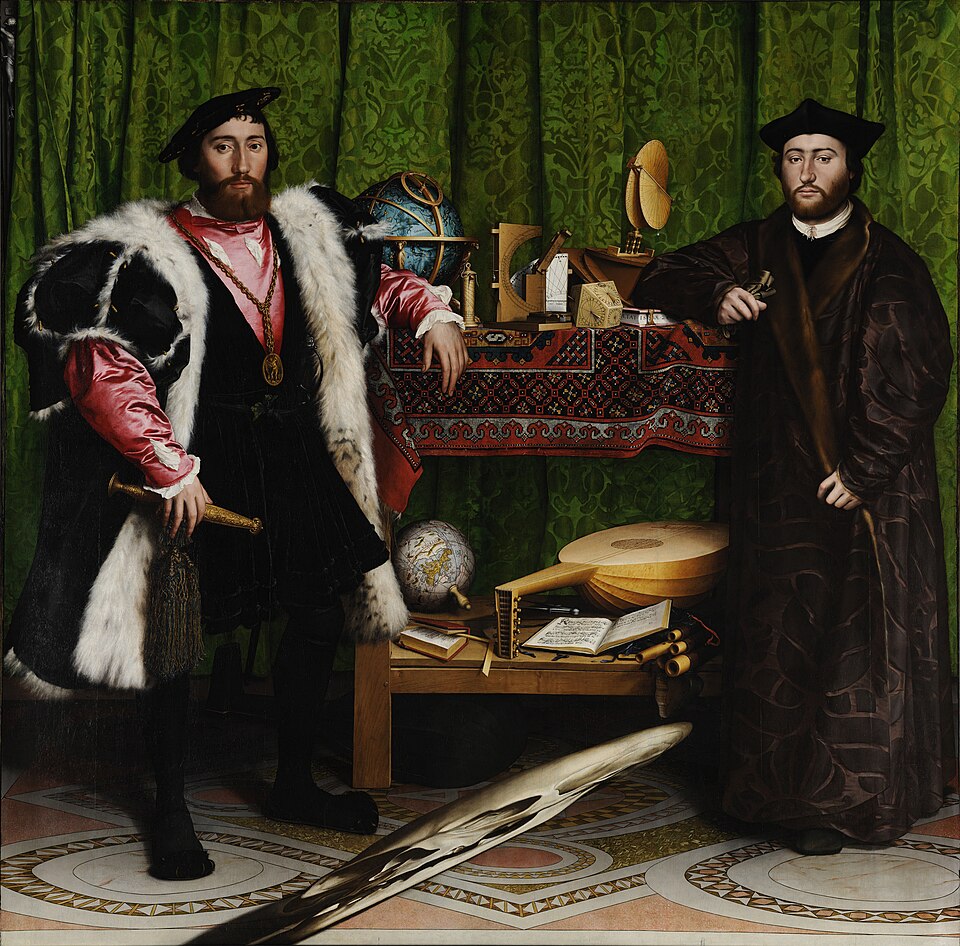
    Hans Holbein the Younger, The Ambassadors (1533), with the anamorphic skull across the foreground
    Hans Holbein the Younger, The Ambassadors, 1533. National Gallery, London. The elongated shape in the foreground is an anamorphic skull.
    Hans Holbein the Younger, The Ambassadors, 1533. National Gallery, London. Public domain, via Wikimedia Commons (Google Art Project).

    Perspective anamorphosis

    An image revealed by movement

    Perspective, or oblique, anamorphosis relies on viewing an image from an unusual angle.

    Viewed straight on, the drawing may look dramatically stretched. Seen from the precise position for which it was designed, the geometry appears to return to normal.

    One of the most celebrated historical examples is the hidden skull in Hans Holbein the Younger's The Ambassadors (1533).

    Perspective anamorphosis is also used in contemporary murals, pavement drawings, installations and architectural artworks.

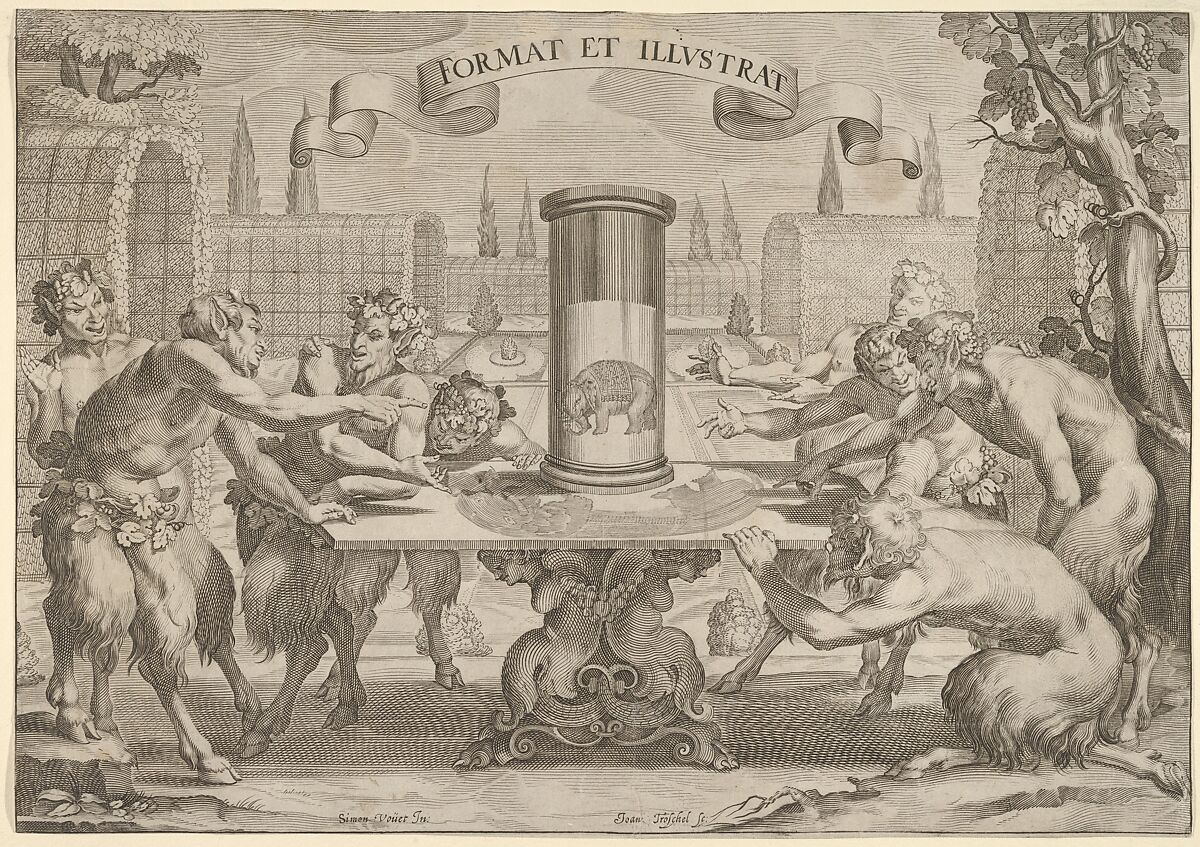
    Seventeenth-century engraving of satyrs watching a cylindrical mirror reflect an elephant from a distorted drawing
    Hans Troschel, after Simon Vouet, Satyrs Admiring the Anamorphosis of an Elephant, 17th century. The Metropolitan Museum of Art. Public domain.
    The Metropolitan Museum of Art. Public domain (Open Access).

    Mirror anamorphosis

    An image revealed by reflection

    Mirror, or catoptric, anamorphosis uses a reflective surface to transform a distorted image into a recognisable one.

    A cylindrical mirror is a particularly striking example.

    A drawing or sculpture arranged around the mirror may appear abstract or fragmented when viewed directly. Its reflection reveals a completely different visual arrangement.

    Other forms of catoptric anamorphosis employ conical or differently curved mirrors.

    This technique became especially prominent in seventeenth-century investigations of optics and perspective and remains important in contemporary sculptural practice.

    The History of Anamorphosis

    Anamorphosis emerged from artists' growing understanding of perspective during the Renaissance. Over subsequent centuries, it developed into a sophisticated field of optical experimentation, connecting visual art with mathematics, physics, philosophy and the study of perception.

    1. Late 15th–early 16th century

      Renaissance: Leonardo da Vinci

      The earliest surviving experiments

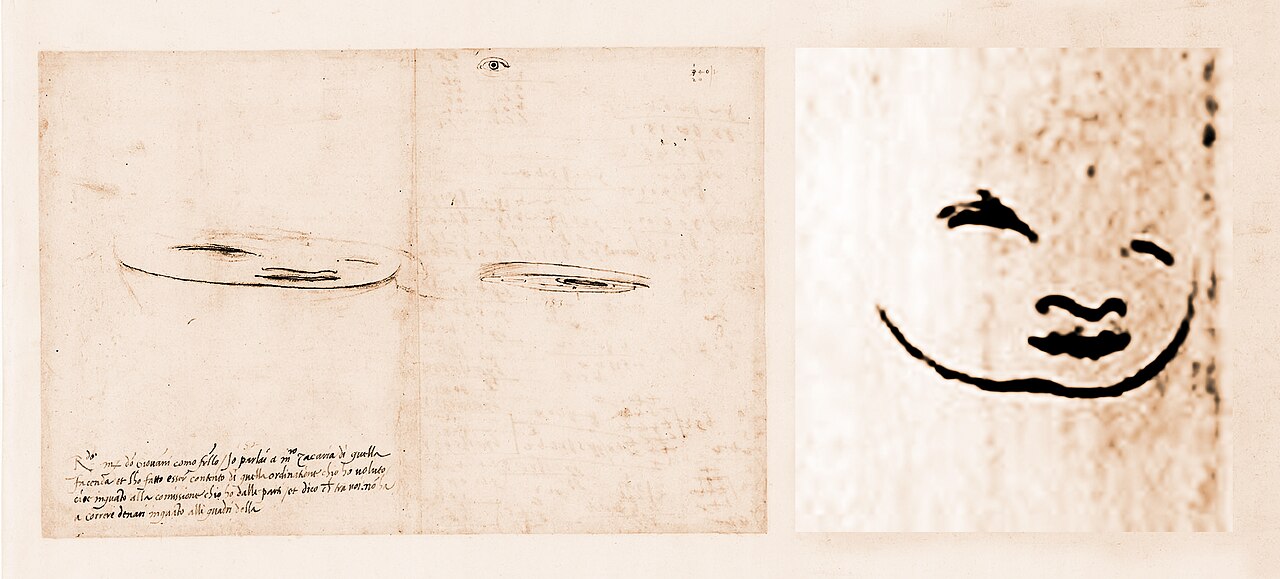
      Leonardo da Vinci's notebooks contain some of the earliest known surviving examples of oblique anamorphic drawing.

      In the Codex Atlanticus, drawings of a child's face and an eye appear dramatically elongated. Viewed from an appropriately shallow angle, their proportions become more recognisable.

      These experiments reveal how Renaissance artists were discovering that perspective was not merely a way to imitate reality. It could also be used to transform or conceal visual information.

      Source: Wikimedia Commons — image record
      Modern illustrated reconstruction of Leonardo da Vinci's elongated anamorphic studies of an eye and a child's face
      Leonardo da Vinci's early anamorphic studies of an eye and a child's face, shown in a modern illustrated reconstruction.
      Modern illustrated reconstruction by IoRinascimento, CC BY-SA 4.0, via Wikimedia Commons.
    2. 1533

      1533: Hans Holbein

      A skull hidden in plain sight

      In 1533, Hans Holbein the Younger painted The Ambassadors, one of the most famous examples of anamorphosis in Western art.

      The painting depicts Jean de Dinteville and Georges de Selve surrounded by objects associated with knowledge, learning and worldly achievement.

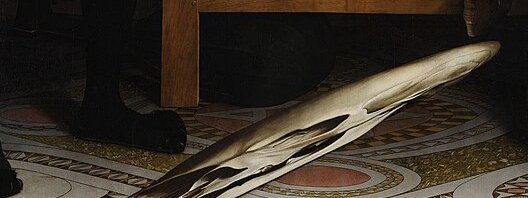
      Across the foreground lies a mysterious elongated shape.

      Viewed from a steep angle, the shape resolves into a human skull.

      The skull is widely interpreted as a memento mori—a reminder of mortality.

      Holbein's extraordinary achievement was to make the viewer's physical position part of the painting's meaning.

      Source: The National Gallery, London
      Detail of the anamorphic skull in Holbein's The Ambassadors
      Close-up of the skull. Digital demonstration only: compressing the detail along its long axis approximates the foreshortening seen from the side of the painting, where the skull becomes recognisable. It is not a second original.
    3. 1546

      1546: A prince stretched across a panel

      Anamorphosis as a courtly showpiece

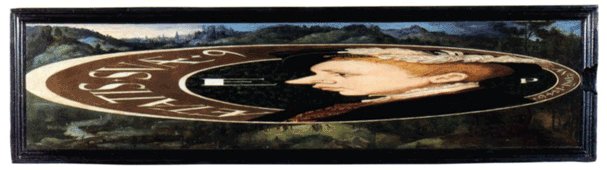
      Thirteen years after The Ambassadors, a painter at the English court went further and built an entire portrait out of the distortion.

      The panel shows Prince Edward, nine years old and a year away from the throne. Seen head-on it is an unreadable smear of flesh tones laid across a landscape.

      Approached from the edge of the panel, at a shallow angle, the smear tightens into a crisp profile of the boy.

      It was almost certainly made to be shown with a viewing device, as a demonstration of the painter's command of perspective. The attribution to William Scrots has never been proven.

      Source: National Portrait Gallery, London — NPG 1299
      The anamorphic portrait of Prince Edward: a face smeared horizontally across a wide, shallow panel
      Attributed to William Scrots, Edward VI, 1546. National Portrait Gallery, London (NPG 1299). The panel is far wider than it is tall because the face has been stretched sideways.
      Attributed to William Scrots, c. 1546. Public domain, via Wikimedia Commons.
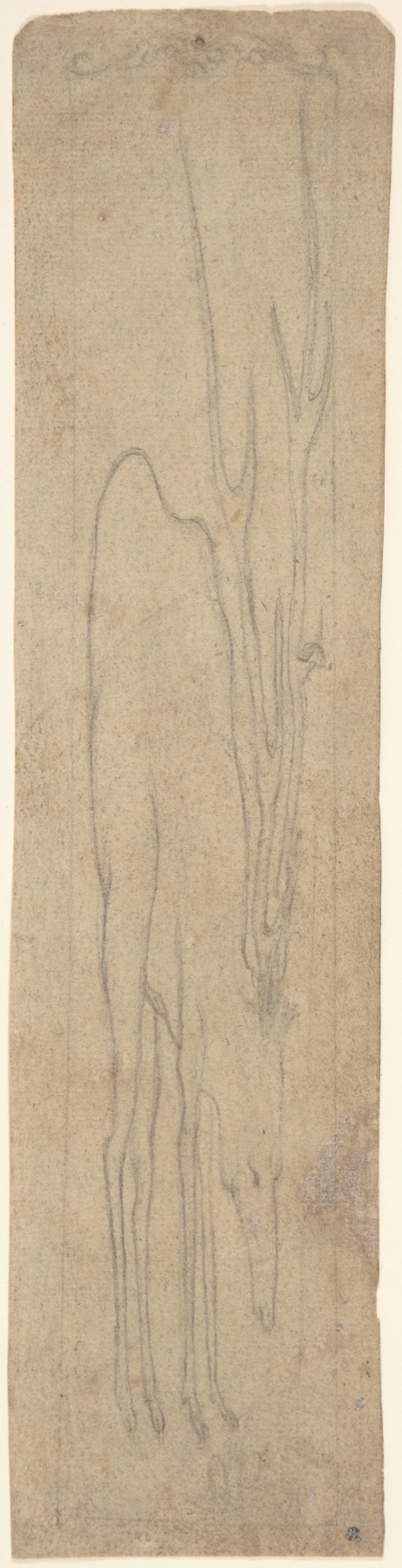
      A sixteenth-century drawing of a stag stretched into an extremely tall, narrow sheet
      The same trick stretched the other way: an anonymous sixteenth-century stag, drawn on a sheet nearly four times taller than it is wide.
      Anamorphic Drawing of a Stag, 16th century, anonymous. The Metropolitan Museum of Art, CC0.
    4. 17th century

      17th century: The mathematics of illusion

      When anamorphosis became an optical science

      During the seventeenth century, mathematicians and artists developed increasingly systematic ways of constructing anamorphic images.

      Jean-François Niceron, a French mathematician and member of the Minim religious order, published La Perspective Curieuse in 1638.

      His work explained how geometric methods could produce images that appeared coherent from special viewpoints or in curved mirrors.

      Niceron and his fellow Minim Emmanuel Maignan then took the method off the page and onto the walls of their own convent. In 1642, in a corridor at Trinita dei Monti in Rome, Maignan painted Saint Francis of Paola so that the figure only assembles from the far end of the passage. Seen square on, it is an empty landscape under a vast sky.

      Niceron painted Saint John writing the Apocalypse on the opposite wall in the same year. Walking the corridor is itself the mechanism: the picture gathers as you approach the viewing point and dissolves again as you pass it.

      The period saw sophisticated experiments using cylindrical and conical mirrors, geometrical grids and architectural spaces.

      Anamorphosis became more than a curiosity: it was a practical demonstration of the mathematics of vision.

      Source: Linda Hall Library — Jean-François Niceron
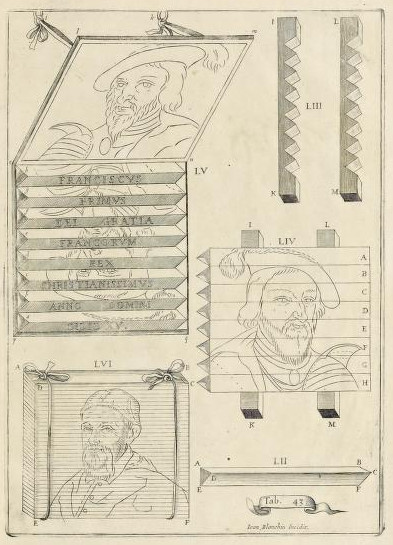
      A plate from Niceron's 1638 treatise showing the geometric construction of an anamorphic image
      Niceron's own plate from La Perspective Curieuse, 1638 — the construction grid that turned the trick into a method.
      Jean-Francois Niceron, La Perspective Curieuse, 1638. Public domain, via Wikimedia Commons.
    5. 1685

      1685: The dome that is not there

      Architecture painted onto a flat canvas

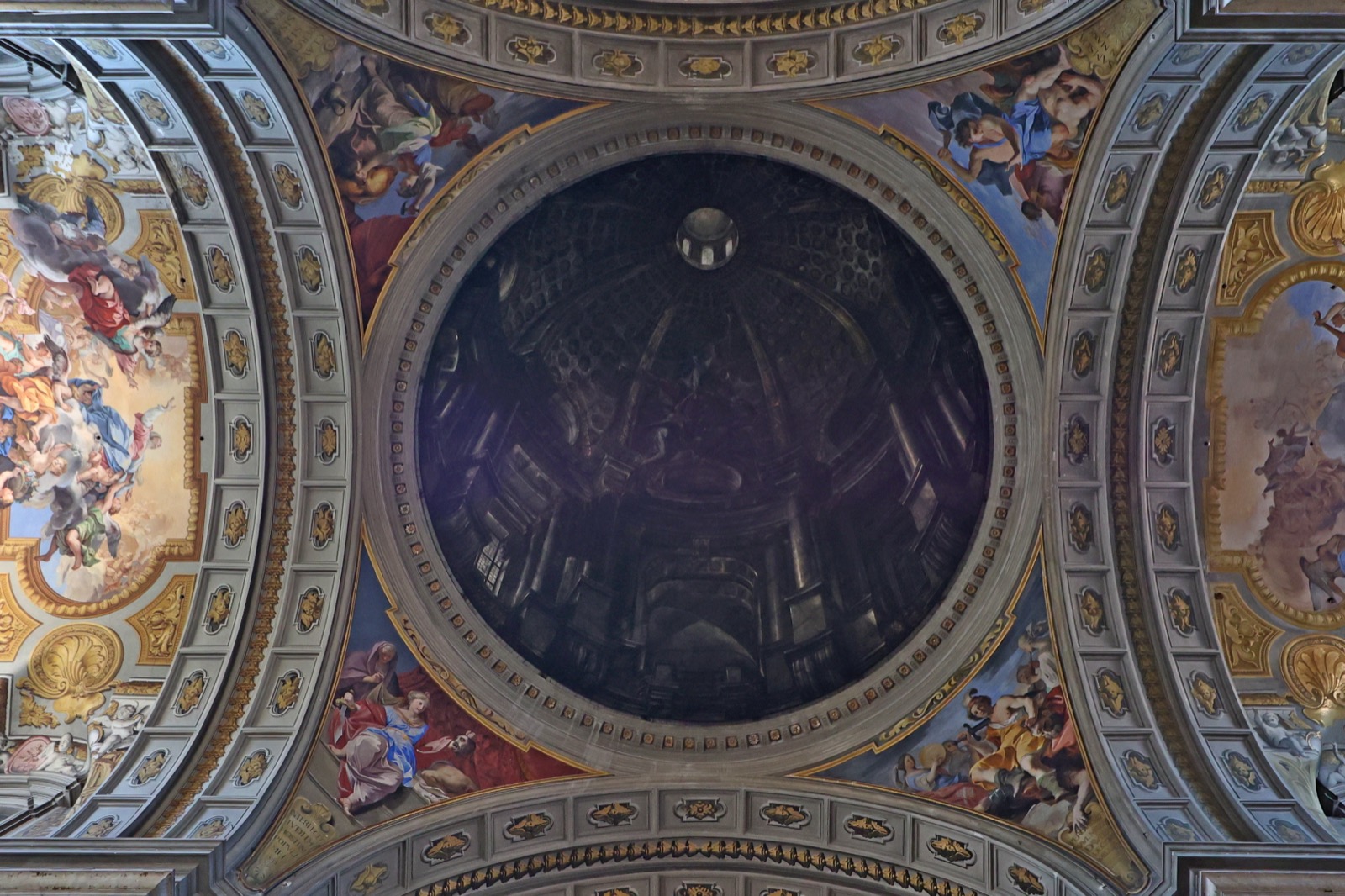
      At Sant'Ignazio in Rome, Andrea Pozzo painted a ribbed cupola rising above the body of the church. There is no cupola. There is a flat canvas.

      The illusion closes from one position, and the church tells you where that is: a disc set into the floor of the nave marks the spot.

      Stand on it and the architecture lifts convincingly into the sky. Walk a few paces and the coffering shears, the ribs slide out of true and the dome settles back into paint.

      It is the plainest statement in the whole history of the technique. The work is not finished until the viewer stands in the right place.

      Source: Wikimedia Commons — image record
      The painted false dome of Sant'Ignazio in Rome, seen from below
      Andrea Pozzo's false cupola at Sant'Ignazio, Rome. The ribs, coffering and open sky are paint on a flat canvas.
      Photograph by Monica Rondoni, CC BY-SA 4.0, via Wikimedia Commons.
    6. 18th–19th century

      18th and 19th centuries: Optical entertainment

      From scientific experiment to popular fascination

      As knowledge of optical projection spread, anamorphic images appeared in illustrated prints, educational demonstrations and visual entertainments.

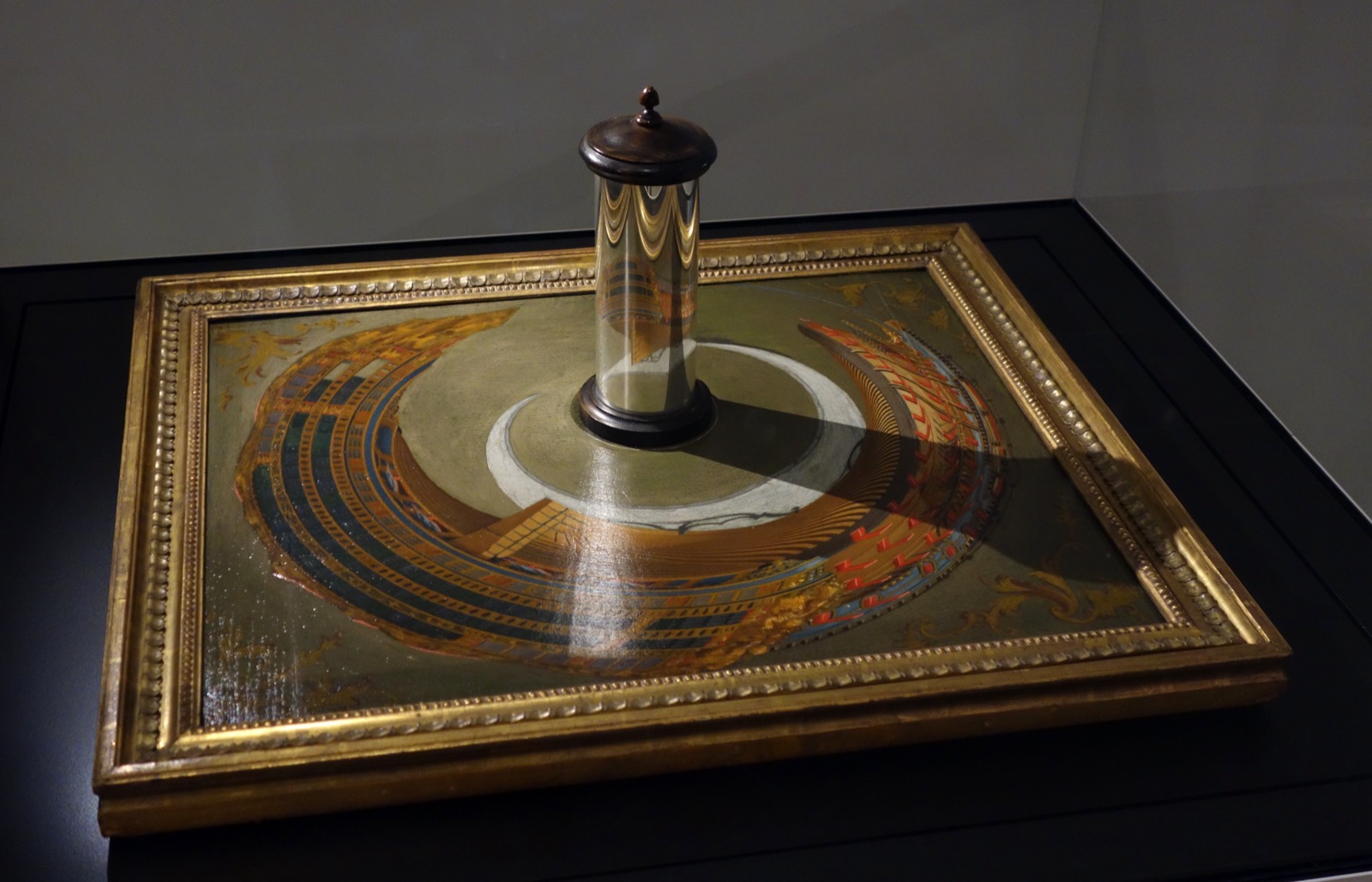
      Surviving objects show how ordinary the technique had become. A panel of about 1750, now in the Science Museum in London, carries an anamorphic painting of a ship.

      Curved mirrors and unusual viewing devices allowed audiences to participate directly in the revelation of hidden images.

      The technique illustrated an enduring fascination: the difference between what the eye receives and what the mind believes it sees.

      An eighteenth-century anamorphic painting of a ship, displayed in the Science Museum, London
      An anamorphic painting of a ship, about 1750. Science Museum, London — by this date the technique had become a popular amusement.
      Science Museum, London. Photograph by Daderot, CC0, via Wikimedia Commons.
    7. 20th–21st century

      20th century to today: Art escapes the frame

      Anamorphosis enters architecture and public space

      Contemporary artists expanded anamorphic principles into streets, buildings, sculptural installations and entire environments.

      Swiss artist Felice Varini has created large-scale geometric installations that align into coherent shapes from particular viewpoints.

      Hungarian artist István Orosz has explored distorted drawings and mirror-based imagery through intricate graphic work.

      These artists show that anamorphosis remains a powerful tool for questioning the relationship between physical space, visual representation and the observer.

      One ring, painted across a whole room

      A perfect circle is cast from a single standing position onto whatever surface each sight-line happens to meet — floor, back wall, side walls. The paint is then applied exactly there. Walk anywhere else and the circle is 4 unrelated fragments.

      Calculated, not drawn by hand: each sight-line is intersected with the room and the fragments break exactly where the walls meet. This is the principle behind room- and building-scale installations; it is not a reproduction of any particular artwork.
    8. 21st century

      21st century: Computational anamorphic sculpture

      From Renaissance geometry to algorithms

      Digital modelling and computational geometry offer artists new methods for designing complex anamorphic forms.

      Rather than working only with distorted drawings, artists can calculate how three-dimensional surfaces will appear in the reflection of curved mirrors.

      Artist and engineer Jonty Hurwitz has explored this approach through sculptures in which seemingly abstract physical forms resolve into recognisable subjects in polished cylindrical mirrors.

      The process brings together artistic composition, computer algorithms, geometric transformation and traditional sculptural fabrication.

      The central question, however, remains the same one that fascinated Renaissance artists:

      How much of what we see depends on where we stand?

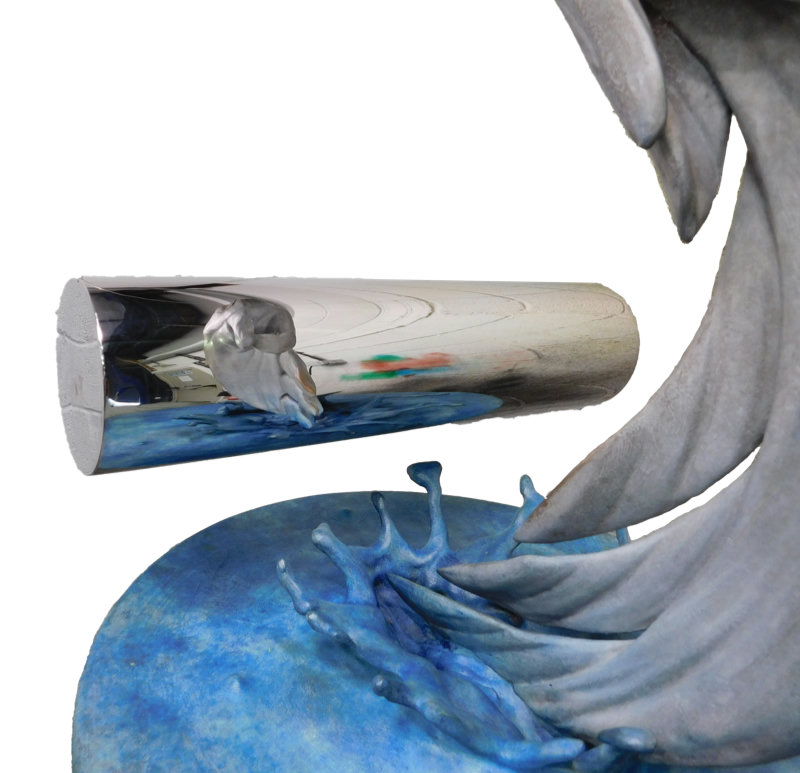
      Conciseness (dolphin) by Jonty Hurwitz: a distorted dolphin sculpture and its reflection in a mirror cylinder
      Jonty Hurwitz, Conciseness (dolphin), 2017.

    Anamorphosis in the Age of Computation

    When Renaissance perspective meets contemporary sculpture.

    Centuries after Leonardo's experiments and Niceron's mathematical investigations, anamorphosis continues to evolve.

    In the sculptural practice of Jonty Hurwitz, the geometry of distortion becomes a way to create physical objects that contain more than one visual identity.

    A sculpture may present an abstract arrangement of material when seen directly. Yet in a precisely positioned cylindrical mirror, the same object reveals a recognisable figure.

    The transformation is not achieved by changing the sculpture. It is produced by the relationship between its form, the reflective surface and the observer.

    Hurwitz's work explores this intersection between computation, physical material and perception.

    Across the wider practice of Jonty Hurwitz and Dr. Yifat Davidoff, these ideas connect to questions about consciousness, interpretation and the limits of human sight.

    The result is art that does more than depict a subject. It asks the viewer to participate in discovering it.

    Explore Anamorphic Sculptures

    What Anamorphosis Teaches Us About Seeing

    Anamorphosis is more than an optical trick. It demonstrates an important distinction between the physical world and our interpretation of it.

    The same object can produce profoundly different visual impressions depending on the observer's position.

    In ordinary life, our visual system is remarkably effective at interpreting perspective and maintaining the apparent stability of objects as we move.

    Anamorphic art deliberately challenges those processes.

    What first appears distorted can become coherent. What appears abstract may conceal something familiar.

    This makes anamorphosis a particularly rich subject for the study of art, mathematics, optics and visual perception.

    Mathematics

    Perspective transformations and reflective geometry can produce surprising visual effects.

    Perception

    Visual experience depends on the relationship between objects, light and observers.

    Philosophy

    Anamorphosis raises questions about appearance, interpretation and the possibility of multiple valid perspectives.

    Sometimes, understanding what we see requires changing where we stand.

    Experience Anamorphosis Yourself

    Try changing your perspective

    A design has been drawn flat on paper, deliberately stretched. Lower your viewing angle with the slider. At 18° the geometry returns to normal.

    Viewed from 88° above the paper, the square appears 2.2× taller than it is wide.

    Discover mirror anamorphosis

    Left: the drawing printed on paper around a cylindrical mirror, seen from above. Right: what a viewer standing in front, looking down at 35°, sees reflected in the cylinder. Both were calculated by reflecting each sight-line off the curved surface.

    On the paper (top view) — viewer at the bottom

    In the mirror — the hidden face

    Light from each point of the drawing strikes the curved mirror and is reflected towards the eye. Because the cylinder curves away on both sides, a narrow strip of the reflection corresponds to a wide arc on the paper — so the face must be spread into a fan around the base to look correct in the mirror.

    The artwork stays the same. The viewing geometry changes.

    Can You Make Your Own Anamorphic Drawing?

    You don't need advanced software to experiment with anamorphosis. A simple drawing, a grid and an unusual viewing angle can demonstrate the underlying principle.

    1. Draw a simple shape or letter on a square grid.
    2. Choose a low viewing position close to your paper.
    3. Use perspective construction to transfer the drawing onto an elongated grid.
    4. Reproduce the transformed lines carefully.
    5. Observe the result from the chosen low angle and compare it with the front view.

    The correct amount and direction of stretching depend on the intended viewing geometry. Stretching an image at random will not produce a mathematically correct anamorphosis.

    Go deeper: the mathematics of distorted projection →
    The stretched grid you draw on
    The square grid you see

    Two cells of the same column are shaded. On the paper the far one covers 14× the area of the near one. From the design viewpoint they are identical squares.

    Frequently Asked Questions about Anamorphosis

    What is anamorphosis in simple terms?

    Anamorphosis is a technique for making an image or object look distorted from ordinary viewpoints but recognisable from a particular angle or through a curved mirror.

    Who invented anamorphosis?

    There is no single universally agreed inventor. Some of the earliest surviving examples of oblique anamorphosis appear in Leonardo da Vinci's notebooks. The technique developed further during the Renaissance and seventeenth century.

    What is the most famous example of anamorphosis?

    Hans Holbein the Younger's The Ambassadors (1533) is among the most famous examples. A distorted shape at the bottom of the painting becomes a skull when seen from an oblique angle.

    What is mirror anamorphosis?

    Mirror anamorphosis uses a reflective surface, often cylindrical or conical, to reveal a coherent image from a deliberately distorted drawing or physical arrangement.

    How is anamorphosis different from an ordinary optical illusion?

    Anamorphosis is a particular family of optical effects based on controlled geometric distortion and reconstruction. Optical illusion is a broader category encompassing many different perceptual phenomena.

    How does cylindrical-mirror anamorphosis work?

    A curved mirror changes the apparent position and proportions of the image reflected in it. By designing the distorted artwork for that reflective geometry, an artist can make the intended image recognisable in the mirror.

    Is anamorphosis still used in contemporary art?

    Yes. Artists use anamorphosis in installations, street art, graphic works and sculpture. Modern computational methods also make it possible to design complex three-dimensional anamorphic forms.

    What is anamorphic sculpture?

    Anamorphic sculpture is three-dimensional art designed so that a recognisable subject appears from a specific viewpoint or within a mirror, even though its physical structure may look abstract or fragmented from elsewhere.

    How does Jonty Hurwitz create anamorphic sculptures?

    Hurwitz's sculptural approach brings together computational modelling, geometric transformation and physical fabrication. In his cylindrical-mirror works, distorted sculptural forms produce recognisable reflected images.

    Why is anamorphosis important in art history?

    Anamorphosis connects the history of perspective with optics, mathematics and philosophical questions about perception. It demonstrates how artists can use geometry to make the viewer's physical position part of an artwork.
    Further Reading & Historical Sources

    Related on sentient.art: Anamorphosis in the studio's practice · Anamorphic sculpture · The gallery

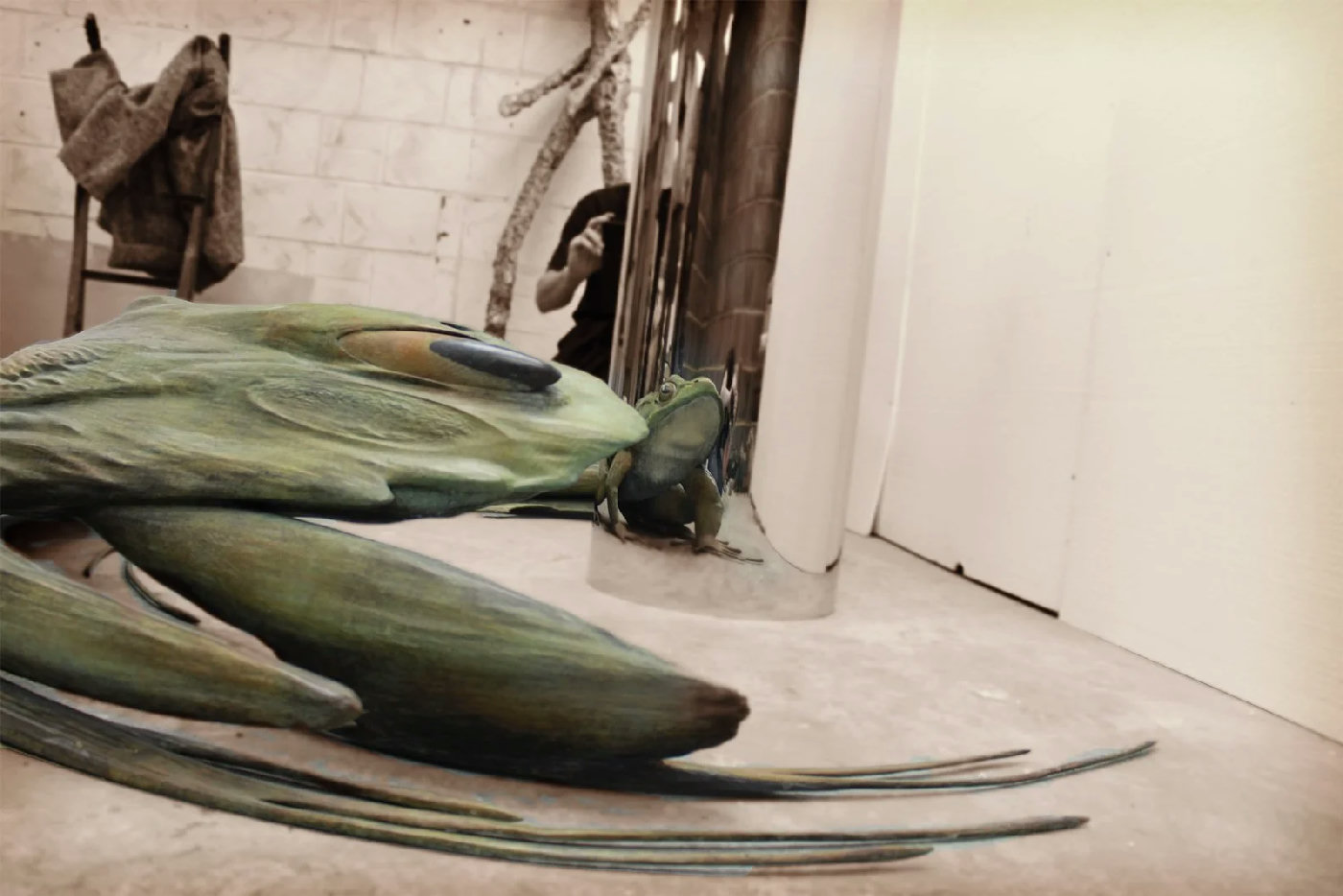
    Extinction? by Jonty Hurwitz: large green anamorphic frog sculpture beside a tall steel cylindrical mirror

    Art Changes When You Change Perspective.

    For more than five centuries, anamorphosis has challenged the assumption that seeing is straightforward.

    Today, Jonty Hurwitz and Dr. Yifat Davidoff continue to explore the relationship between science, sculpture and perception.

    Discover artworks that invite you to look again.

    Anamorphosis: Definition, History & the Art of Hidden Images

    Discover anamorphosis: its definition, Renaissance history, famous examples, mirror illusions and modern sculpture, from Leonardo to Jonty Hurwitz.

    What if an object could hide its true identity in plain sight?

    For centuries, artists have used mathematics and optical illusion to create images that appear distorted, fragmented or even meaningless—until you look from exactly the right place.

    This is anamorphosis: an extraordinary meeting of art, geometry and human perception.

    From Leonardo da Vinci's Renaissance experiments to the computational sculptures of Jonty Hurwitz, discover how artists have transformed the act of seeing into an artistic experience.

    What Is Anamorphosis?

    Anamorphosis is an artistic technique in which an image or physical form is deliberately distorted so that it appears recognisable only when viewed from a particular position or reflected in a specially shaped mirror.

    The distortion is not random.

    It is calculated using principles of perspective and optics.

    A shape that appears meaningless from one position can become a perfectly recognisable image from another.

    The word anamorphosis derives from Greek roots associated with forming or reshaping something again.

    In conventional perspective drawing, artists represent three-dimensional space on a flat surface.

    Anamorphic art reverses the viewer's expectations: an image is intentionally stretched, compressed or rearranged so that the correct viewing geometry restores its intended appearance.

    This creates an unusual relationship between the artwork and its observer.

    The viewer does not merely look at an anamorphic work.

    Finding the right perspective becomes part of experiencing it.

    How Does Anamorphosis Work?

    Every anamorphic artwork begins with a relationship between geometry and observation.

    The artist determines what an image should look like from a chosen viewpoint.

    Geometric construction then determines how the physical drawing or object must be altered to produce that appearance.

    Seen from elsewhere, the distortion remains visible.

    From the intended position, the apparent proportions change and the hidden image becomes recognisable.

    01 — Start with a recognisable image.

    An artist begins with a face, an animal, a geometric pattern or another subject.

    02 — Calculate the distortion.

    Perspective projection, geometric grids or mathematical models are used to transform the image into a deliberately distorted arrangement.

    03 — Reveal the hidden form.

    The original appearance emerges when the viewer moves to the calculated position or observes the reflection in a suitable mirror.

    Perspective anamorphosis: An image revealed by movement.

    Perspective, or oblique, anamorphosis relies on viewing an image from an unusual angle.

    Viewed straight on, the drawing may look dramatically stretched.

    Seen from the precise position for which it was designed, the geometry appears to return to normal.

    One of the most celebrated historical examples is the hidden skull in Hans Holbein the Younger's The Ambassadors (1533).

    Perspective anamorphosis is also used in contemporary murals, pavement drawings, installations and architectural artworks.

    Mirror anamorphosis: An image revealed by reflection.

    Mirror, or catoptric, anamorphosis uses a reflective surface to transform a distorted image into a recognisable one.

    A cylindrical mirror is a particularly striking example.

    A drawing or sculpture arranged around the mirror may appear abstract or fragmented when viewed directly.

    Its reflection reveals a completely different visual arrangement.

    Other forms of catoptric anamorphosis employ conical or differently curved mirrors.

    This technique became especially prominent in seventeenth-century investigations of optics and perspective and remains important in contemporary sculptural practice.

    The History of Anamorphosis.

    Anamorphosis emerged from artists' growing understanding of perspective during the Renaissance.

    Over subsequent centuries, it developed into a sophisticated field of optical experimentation, connecting visual art with mathematics, physics, philosophy and the study of perception.

    Renaissance: Leonardo da Vinci — The earliest surviving experiments.

    Leonardo da Vinci's notebooks contain some of the earliest known surviving examples of oblique anamorphic drawing.

    In the Codex Atlanticus, drawings of a child's face and an eye appear dramatically elongated.

    Viewed from an appropriately shallow angle, their proportions become more recognisable.

    These experiments reveal how Renaissance artists were discovering that perspective was not merely a way to imitate reality.

    It could also be used to transform or conceal visual information.

    1533: Hans Holbein — A skull hidden in plain sight.

    In 1533, Hans Holbein the Younger painted The Ambassadors, one of the most famous examples of anamorphosis in Western art.

    The painting depicts Jean de Dinteville and Georges de Selve surrounded by objects associated with knowledge, learning and worldly achievement.

    Across the foreground lies a mysterious elongated shape.

    Viewed from a steep angle, the shape resolves into a human skull.

    The skull is widely interpreted as a memento mori—a reminder of mortality.

    Holbein's extraordinary achievement was to make the viewer's physical position part of the painting's meaning.

    1546: A prince stretched across a panel — Anamorphosis as a courtly showpiece.

    Thirteen years after The Ambassadors, a painter at the English court went further and built an entire portrait out of the distortion.

    The panel shows Prince Edward, nine years old and a year away from the throne.

    Seen head-on it is an unreadable smear of flesh tones laid across a landscape.

    Approached from the edge of the panel, at a shallow angle, the smear tightens into a crisp profile of the boy.

    It was almost certainly made to be shown with a viewing device, as a demonstration of the painter's command of perspective.

    The attribution to William Scrots has never been proven.

    17th century: The mathematics of illusion — When anamorphosis became an optical science.

    During the seventeenth century, mathematicians and artists developed increasingly systematic ways of constructing anamorphic images.

    Jean-François Niceron, a French mathematician and member of the Minim religious order, published La Perspective Curieuse in 1638.

    His work explained how geometric methods could produce images that appeared coherent from special viewpoints or in curved mirrors.

    Niceron and his fellow Minim Emmanuel Maignan then took the method off the page and onto the walls of their own convent.

    In 1642, in a corridor at Trinita dei Monti in Rome, Maignan painted Saint Francis of Paola so that the figure only assembles from the far end of the passage.

    Seen square on, it is an empty landscape under a vast sky.

    Niceron painted Saint John writing the Apocalypse on the opposite wall in the same year.

    Walking the corridor is itself the mechanism: the picture gathers as you approach the viewing point and dissolves again as you pass it.

    The period saw sophisticated experiments using cylindrical and conical mirrors, geometrical grids and architectural spaces.

    Anamorphosis became more than a curiosity: it was a practical demonstration of the mathematics of vision.

    1685: The dome that is not there — Architecture painted onto a flat canvas.

    At Sant'Ignazio in Rome, Andrea Pozzo painted a ribbed cupola rising above the body of the church.

    There is no cupola.

    There is a flat canvas.

    The illusion closes from one position, and the church tells you where that is: a disc set into the floor of the nave marks the spot.

    Stand on it and the architecture lifts convincingly into the sky.

    Walk a few paces and the coffering shears, the ribs slide out of true and the dome settles back into paint.

    It is the plainest statement in the whole history of the technique.

    The work is not finished until the viewer stands in the right place.

    18th and 19th centuries: Optical entertainment — From scientific experiment to popular fascination.

    As knowledge of optical projection spread, anamorphic images appeared in illustrated prints, educational demonstrations and visual entertainments.

    Surviving objects show how ordinary the technique had become.

    A panel of about 1750, now in the Science Museum in London, carries an anamorphic painting of a ship.

    Curved mirrors and unusual viewing devices allowed audiences to participate directly in the revelation of hidden images.

    The technique illustrated an enduring fascination: the difference between what the eye receives and what the mind believes it sees.

    20th century to today: Art escapes the frame — Anamorphosis enters architecture and public space.

    Contemporary artists expanded anamorphic principles into streets, buildings, sculptural installations and entire environments.

    Swiss artist Felice Varini has created large-scale geometric installations that align into coherent shapes from particular viewpoints.

    Hungarian artist István Orosz has explored distorted drawings and mirror-based imagery through intricate graphic work.

    These artists show that anamorphosis remains a powerful tool for questioning the relationship between physical space, visual representation and the observer.

    21st century: Computational anamorphic sculpture — From Renaissance geometry to algorithms.

    Digital modelling and computational geometry offer artists new methods for designing complex anamorphic forms.

    Rather than working only with distorted drawings, artists can calculate how three-dimensional surfaces will appear in the reflection of curved mirrors.

    Artist and engineer Jonty Hurwitz has explored this approach through sculptures in which seemingly abstract physical forms resolve into recognisable subjects in polished cylindrical mirrors.

    The process brings together artistic composition, computer algorithms, geometric transformation and traditional sculptural fabrication.

    The central question, however, remains the same one that fascinated Renaissance artists: How much of what we see depends on where we stand?

    Anamorphosis in the Age of Computation.

    Centuries after Leonardo's experiments and Niceron's mathematical investigations, anamorphosis continues to evolve.

    In the sculptural practice of Jonty Hurwitz, the geometry of distortion becomes a way to create physical objects that contain more than one visual identity.

    A sculpture may present an abstract arrangement of material when seen directly.

    Yet in a precisely positioned cylindrical mirror, the same object reveals a recognisable figure.

    The transformation is not achieved by changing the sculpture.

    It is produced by the relationship between its form, the reflective surface and the observer.

    Hurwitz's work explores this intersection between computation, physical material and perception.

    Across the wider practice of Jonty Hurwitz and Dr.

    Yifat Davidoff, these ideas connect to questions about consciousness, interpretation and the limits of human sight.

    The result is art that does more than depict a subject.

    It asks the viewer to participate in discovering it.

    What Anamorphosis Teaches Us About Seeing.

    Anamorphosis is more than an optical trick.

    It demonstrates an important distinction between the physical world and our interpretation of it.

    The same object can produce profoundly different visual impressions depending on the observer's position.

    In ordinary life, our visual system is remarkably effective at interpreting perspective and maintaining the apparent stability of objects as we move.

    Anamorphic art deliberately challenges those processes.

    What first appears distorted can become coherent.

    What appears abstract may conceal something familiar.

    This makes anamorphosis a particularly rich subject for the study of art, mathematics, optics and visual perception.

    Sometimes, understanding what we see requires changing where we stand.

    Can You Make Your Own Anamorphic Drawing?

    You don't need advanced software to experiment with anamorphosis.

    A simple drawing, a grid and an unusual viewing angle can demonstrate the underlying principle.

    Draw a simple shape or letter on a square grid.

    Choose a low viewing position close to your paper.

    Use perspective construction to transfer the drawing onto an elongated grid.

    Reproduce the transformed lines carefully.

    Observe the result from the chosen low angle and compare it with the front view.

    The correct amount and direction of stretching depend on the intended viewing geometry.

    Stretching an image at random will not produce a mathematically correct anamorphosis.

    What is anamorphosis in simple terms?

    Anamorphosis is a technique for making an image or object look distorted from ordinary viewpoints but recognisable from a particular angle or through a curved mirror.

    Who invented anamorphosis?

    There is no single universally agreed inventor.

    Some of the earliest surviving examples of oblique anamorphosis appear in Leonardo da Vinci's notebooks.

    The technique developed further during the Renaissance and seventeenth century.

    What is the most famous example of anamorphosis?

    Hans Holbein the Younger's The Ambassadors (1533) is among the most famous examples.

    A distorted shape at the bottom of the painting becomes a skull when seen from an oblique angle.

    What is mirror anamorphosis?

    Mirror anamorphosis uses a reflective surface, often cylindrical or conical, to reveal a coherent image from a deliberately distorted drawing or physical arrangement.

    How is anamorphosis different from an ordinary optical illusion?

    Anamorphosis is a particular family of optical effects based on controlled geometric distortion and reconstruction.

    Optical illusion is a broader category encompassing many different perceptual phenomena.

    How does cylindrical-mirror anamorphosis work?

    A curved mirror changes the apparent position and proportions of the image reflected in it.

    By designing the distorted artwork for that reflective geometry, an artist can make the intended image recognisable in the mirror.

    Is anamorphosis still used in contemporary art?

    Yes.

    Artists use anamorphosis in installations, street art, graphic works and sculpture.

    Modern computational methods also make it possible to design complex three-dimensional anamorphic forms.

    What is anamorphic sculpture?

    Anamorphic sculpture is three-dimensional art designed so that a recognisable subject appears from a specific viewpoint or within a mirror, even though its physical structure may look abstract or fragmented from elsewhere.

    How does Jonty Hurwitz create anamorphic sculptures?

    Hurwitz's sculptural approach brings together computational modelling, geometric transformation and physical fabrication.

    In his cylindrical-mirror works, distorted sculptural forms produce recognisable reflected images.

    Why is anamorphosis important in art history?

    Anamorphosis connects the history of perspective with optics, mathematics and philosophical questions about perception.

    It demonstrates how artists can use geometry to make the viewer's physical position part of an artwork.