Journal/
What Is Anamorphosis? The Mathematics, History, and Science of Distorted Projection
The mathematics, history, and science of anamorphosis — from Leonardo's notebooks and Holbein's hidden skull to computational catoptric sculpture today.
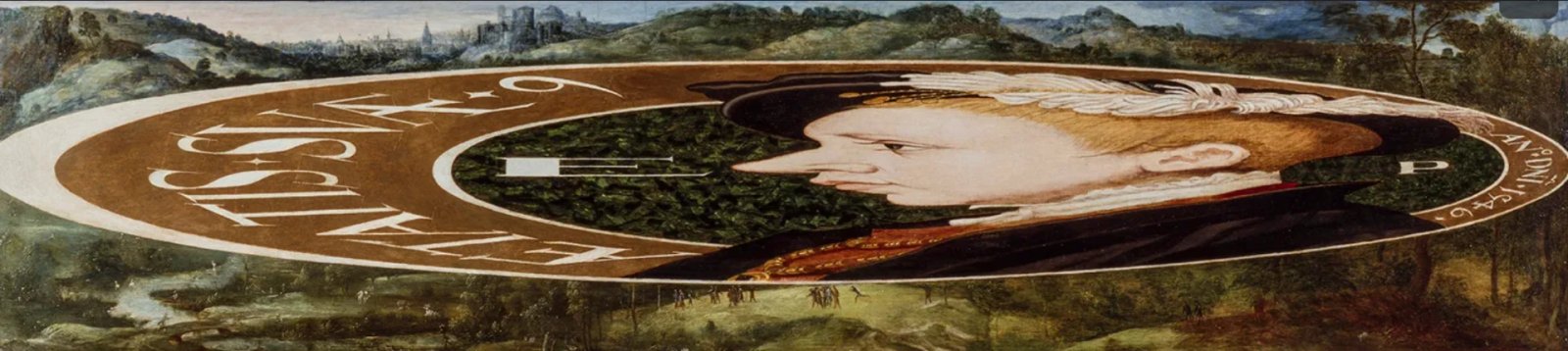
For centuries, a peculiar visual riddle has obsessed artists, mathematicians, and physicists. Picture a canvas smeared with a wild, unrecognizable chaos of paint. It looks like a mistake. Yet, if you stand at one precise, razor-sharp vantage point, or place a curved mirror on the surface, the mess suddenly collapses into a perfect, coherent image.
This is no cheap street-art gimmick. It is something far deeper, living at the exact intersection of projective geometry, optics, and cognitive science. By forcing us to question how we see, the medium exposes a fundamental truth: our reality is just a mental construct, built by the brain from raw light hitting the back of the eye.
Defining Anamorphosis: Etymology and Core Concept
To understand this art, look to the Greek. The prefix ana- means back or again, while morphe translates to shape. It literally means to re-form.
In the studio, this translates to a rigorous physics problem where a distorted projection requires you to use a special device, stand at a precise vantage point, or combine both to reconstruct the image. It is a game of hide and seek with human perception.
At its core, the technique relies on a mathematical mapping system. An image is projected from a normal plane onto a secondary, distorted plane. Without the correct decoding mechanism, like a sharp viewing angle for oblique pieces or a cylindrical mirror for catoptric ones, the work looks like chaos. It is just stretched paint and abstract nonsense until you stand exactly where the artist intended.
How the Brain Resolves Distortion: The Cognitive Psychology of Projection
The magic of anamorphosis does not occur on the canvas or the sculpture itself. It happens inside your visual cortex.
Our brains are hardwired for a trick called perceptual constancy. This survival mechanism automatically adjusts for shifts in angle, lighting, and distance so we can recognize familiar shapes without thinking. When you look at a round coin from an angle, the physical shape hitting your retina is actually a squashed ellipse, yet your brain immediately decodes this flat distortion as a perfect circle existing in three-dimensional space.
Anamorphic art hacks this biological correction system. By reverse-engineering the raw mathematics of perspective, these pieces project a wild, stretched pattern onto your eye that perfectly mimics the light signature of an undistorted object. Once you stand at that single, mathematically calculated viewpoint, your brain stops looking at the physical canvas or the warped bronze. Instead, the visual cortex snaps the chaotic light stream into a clean, coherent form that appears to float in mid-air. Perception is an active interpretation of the world, not a passive recording of it.
The Two Primary Types: Perspective vs. Catoptric Anamorphosis
While the math remains constant, the physical execution splits clean down the middle into two distinct methodologies. In both cases, we are reconstructing a coherent form from a state of total chaos.
Perspective (Oblique) Anamorphosis: The Power of Extreme Angles
Oblique perspective demands physical movement.
With standard linear perspective, you stand comfortably in front of the canvas as parallel lines recede toward a central vanishing point. Oblique projection throws this out. The grid is stretched violently along a severe axis.
To resolve the image, you must press your eye nearly flat against the surface of the artwork, looking across the plane rather than directly at it. This extreme vantage point foreshortens the stretched dimensions, instantly collapsing the chaotic distortion so the true subject can finally lock into place.
Catoptric (Mirror) Anamorphosis: Cylindrical and Conical Reflections
Catoptric systems introduce a physical optical modulator. This is usually a highly polished cylindrical, conical, or spherical mirror placed directly onto a distorted two-dimensional or three-dimensional plane.
```
[ Observer's Eye ]
|
v (Line of sight)
/-----------------\
/ Cylindrical \
| Mirror | <--- Resolves the distorted reflection
\ (Optic Axis) /
\-----------------/
^
| (Reflected light)
=========================
[ Distorted Floor Plane ] <--- Unrecognizable, stretched image
```
Here, the distorted image is painted or sculpted around the base of the central mirror. Viewed directly, the floor plane is nonsense, appearing as a chaotic, circular splash of lines and colors spread out in a useless smear. However, when you look into the curved mirror, the geometry of the reflection reverses the mathematical distortion. A cylindrical mirror compresses the image horizontally while maintaining its vertical scale, translating the radial distortion of the floor plane into a flat, undistorted image floating within the cylinder.
The Evolution of Anamorphosis: A Historical Chronology
The journey of anamorphosis stretches across centuries. It began as a closely guarded workshop secret, morphed into a formalized branch of mathematics, and finally became a tool for modern artistic expression.
```
[15th Century] Leonardo da Vinci's notebook sketches (earliest oblique examples)
|
[1533] Hans Holbein's 'The Ambassadors' popularizes symbolic hidden imagery
|
[17th Century] Jesuit mathematicians formalize projective geometry & catoptric mirrors
|
[Modern Era] Contemporary sculptors integrate algorithmic computation and 3D design
```
Leonardo's Early Renaissance Observations
The earliest known examples of oblique anamorphosis hide inside the notebooks of Leonardo da Vinci. Look specifically at the Codex Atlanticus, dated around 1485.
Leonardo mastered geometry and optics. By stretching human features, like a baby's face or a single eye across a horizontal plane, he realized something profound: the rules of linear perspective could be inverted to hide information in plain sight, meaning a drawing would reveal its secrets only to a viewer standing at one exact spot.
Holbein's Hidden Skull
The most famous historical masterpiece of oblique anamorphosis is The Ambassadors (1533) by Hans Holbein the Younger, which you can see hanging in the National Gallery in London.
A strange, gray, diagonal shape hovers above the floor at the bottom of this grand portrait of two wealthy diplomats. Walk to the far right of the painting, press your eye close to the wall, and the distorted smear suddenly foreshortens into a pristine, realistic human skull. This was a brilliant 16th-century memento mori, a physical reminder of mortality. It warned the viewer that despite the wealth, science, and earthly achievements of the two figures in the frame, death is always waiting to be resolved from the right angle.
The Rise of Projective Geometry
By the 17th century, the technique evolved from a studio secret into a formalized mathematical discipline. Jesuit mathematicians, most notably Jean-François Niceron and Gaspar Schott, published extensive treatises detailing the precise geometric grids required to construct both oblique and catoptric works.
This era saw the birth of projective geometry, which is the study of geometric properties that remain invariant under projection. Anamorphosis quickly became a popular tool for political and religious satire. It allowed artists to hide controversial portraits, erotic scenes, or secret religious symbols in plain sight, knowing they would remain completely invisible to anyone who did not possess the correct cylindrical mirror or viewing tube.
Contemporary Masters of Anamorphic Expression
Today, contemporary artists push the boundaries of perspective and space. We use anamorphic principles to challenge your relationship with physical environments.
| Artist | Primary Medium | Type of Anamorphosis | Spatial/Visual Impact |
| :--- | :--- | :--- | :--- |
| Felice Varini | Architectural paint installations | Oblique (Perspective) | Projects massive geometric shapes onto complex physical architecture that resolve from a single point. |
| István Orosz | Classical printmaking & graphic art | Catoptric (Mirror) & Oblique | Revives Renaissance etching styles, hiding secondary portraits in landscapes resolved via brass cylinders. |
| Markus Raetz | Kinetic & physical sculpture | Perspective / Spatial Shift | Sculptures change form entirely as the viewer walks around them, morphing from one silhouette to another. |
| Jonty Hurwitz | Computational sculpture & physics-based art | Catoptric (Mirror) & Nano-scale | Uses custom algorithms to project complex, organic 3D forms that resolve in cylindrical mirrors. |
Felice Varini: Painting on an Architectural Scale
Swiss artist Felice Varini works with massive spaces. He paints huge, fragmented geometric shapes like circles, triangles, and squares across entire rooms, corridors, and historic villages.
Walk through these spaces and you will see only random, disjointed lines of paint splashed across walls, pillars, and ceilings. It looks like chaos. However, if you stand at the exact, mathematically determined spot in the room, those fragmented lines align perfectly in your field of vision. The math clicks, projecting a unified, flat geometric shape that appears to hover impossibly in the physical space.
István Orosz: Modern Graphic and Mirror Illustration
Hungarian artist István Orosz is a modern master of graphic anamorphosis. Drawing heavily on classical printmaking techniques, Orosz creates intricate, highly detailed illustrations that depict historic scenes or landscapes.
He places a polished brass cylinder right at the center of these prints. The seemingly chaotic lines of the landscape reflect off the metal to reveal a highly detailed portrait, such as Jules Verne or Edgar Allan Poe, hidden within the drawing. Orosz's work bridges the gap between historical engraving and precise geometric projection.
Markus Raetz: Sculptural Shift and Observer Movement
The late Swiss sculptor Markus Raetz took anamorphosis into three dimensions. Raetz's sculptures do not rely on mirrors. Instead, they require you to move.
A physical piece by Raetz might look like a chaotic cluster of metal wires or carved wooden slats from one angle. Walk to the side, and it morphs into a silhouette of a man wearing a hat. Keep moving, and it transforms into a completely different form, such as a rabbit. Raetz demonstrates that form is never static, but a dynamic dialogue between the object, the space, and the moving observer.
Computational Anamorphosis: Shifting the Frontier in 2026
The ancient science of perspective projection has undergone a massive technological shift. While Renaissance masters relied on hand-drawn grids and physical string lines to warp their images, today we have high-performance computing, custom algorithms, and precision engineering.
The edge of this medium now belongs to computational catoptric sculpture. This discipline moves far beyond flat drawings, projecting complex, three-dimensional physical forms onto highly polished reflective surfaces.
```
[3D Organic Model] ---> [Reverse Projection Algorithm] ---> [Computational 3D Printing] ---> [Finished Sculpture + Cylinder Mirror]
```
The Algorithms Behind Modern Catoptric Sculptures
My own work lives at this exact boundary of mathematics, physics, and human perception. To create these pieces, I write custom algorithms that reverse-engineer the laws of light reflection. It is a rigorous process.
To build a contemporary catoptric sculpture, the work begins in the digital space:
1. The Target Form: We design or scan a highly detailed 3D model of a recognizable form, like a human figure, a hand, or an animal.
2. The Reverse Projection: A custom algorithm calculates how light rays travel from the viewer's eye, bounce off a highly polished cylinder of a specific radius, and land on the surrounding surface.
3. The Distortion Map: The algorithm warps, stretches, and deforms the 3D model, pulling it outwards along radial coordinates. This produces a highly distorted, abstract wave of resin, bronze, or copper that looks entirely unrecognizable to the naked eye.
4. The Physical Realization: Using high-precision 3D printing, CNC milling, or traditional casting, we materialize the distorted geometry.
When you place a polished steel cylinder at the exact mathematical center of the sculpture, the chaos resolves. The abstract wave of metal or resin reflects off the curved steel, revealing an incredibly delicate, anatomically perfect human form floating in the mirror.
Science and art merge. Works like Yoda or Rebirthday demonstrate that anamorphosis is far more than a simple visual trick. By using computational geometry to hide perfect forms in plain sight, these sculptures force us to confront the limitations of our own senses, proving that order and chaos are often just a matter of where you stand.
Frequently Asked Questions
What is the meaning of the word anamorphosis?
The word anamorphosis comes from Greek origins, where the prefix "ana-" means back or again, and "morphe" translates to shape. Literally meaning "to re-form," it refers to an art form where a distorted image or sculpture must be reconstituted through a specific viewing angle or optical device.
How does our brain resolve distorted anamorphic art?
Our brains rely on a biological survival mechanism called perceptual constancy, which automatically corrects for shifts in distance, lighting, and angles. Anamorphic art reverse-engineers this system, projecting a highly stretched pattern that mimics the light signature of a normal object. When viewed from the correct mathematical vantage point, the visual cortex instantly snaps this chaotic light stream into a coherent three-dimensional image.
What is the difference between perspective and catoptric anamorphosis?
Perspective (or oblique) anamorphosis relies on viewing an image from an extreme, flat angle across the canvas plane to foreshorten and resolve the distortion. Catoptric anamorphosis uses an optical modulator, such as a cylindrical, conical, or spherical mirror, to mathematically reverse the distortion and project a flat, coherent reflection of the surrounding chaotic image.
Who created the earliest known examples of oblique anamorphosis?
The earliest known examples of oblique anamorphosis are found in the notebook sketches of Leonardo da Vinci, specifically within the Codex Atlanticus dated around 1485. Leonardo used his masterly grasp of geometry and optics to realize that linear perspective could be inverted to hide images—such as a baby's face or an eye—in plain sight.
Why is there a skull hidden in Hans Holbein's painting 'The Ambassadors'?
The distorted diagonal smear at the bottom of Hans Holbein's 1533 painting 'The Ambassadors' is an oblique anamorphic projection of a human skull. It serves as a "memento mori"—a physical reminder of mortality. It was designed to show the wealthy diplomats in the painting, and the viewer, that death is always waiting to be resolved from the correct angle.
How does a cylindrical mirror resolve a distorted drawing?
A cylindrical mirror acts as a physical optical modulator. It compresses the radial distortion of the surrounding image horizontally while preserving its vertical scale. This geometric reversal translates the unrecognizable, stretched smear on the floor plane into a clean, undistorted image that appears to float inside the cylinder.
Why did artists in the 17th century use projective geometry to hide images?
During the 17th century, Jesuit mathematicians formalized the geometric grids needed for anamorphic art. Artists utilized this projective geometry as a clever tool for political and religious satire. It allowed them to conceal controversial portraits, erotic scenes, or secret religious symbols in plain sight, keeping them entirely invisible to anyone without the proper viewing tube or cylindrical mirror.
Does anamorphic art require a viewer to stand in a specific spot?
Yes. For both perspective and catoptric anamorphosis, the image is a mathematical mapping of distorted coordinates. It only resolves into a coherent, recognizable form when the observer views it from a single, mathematically calculated vantage point or uses the correct optical device, like a curved mirror.